

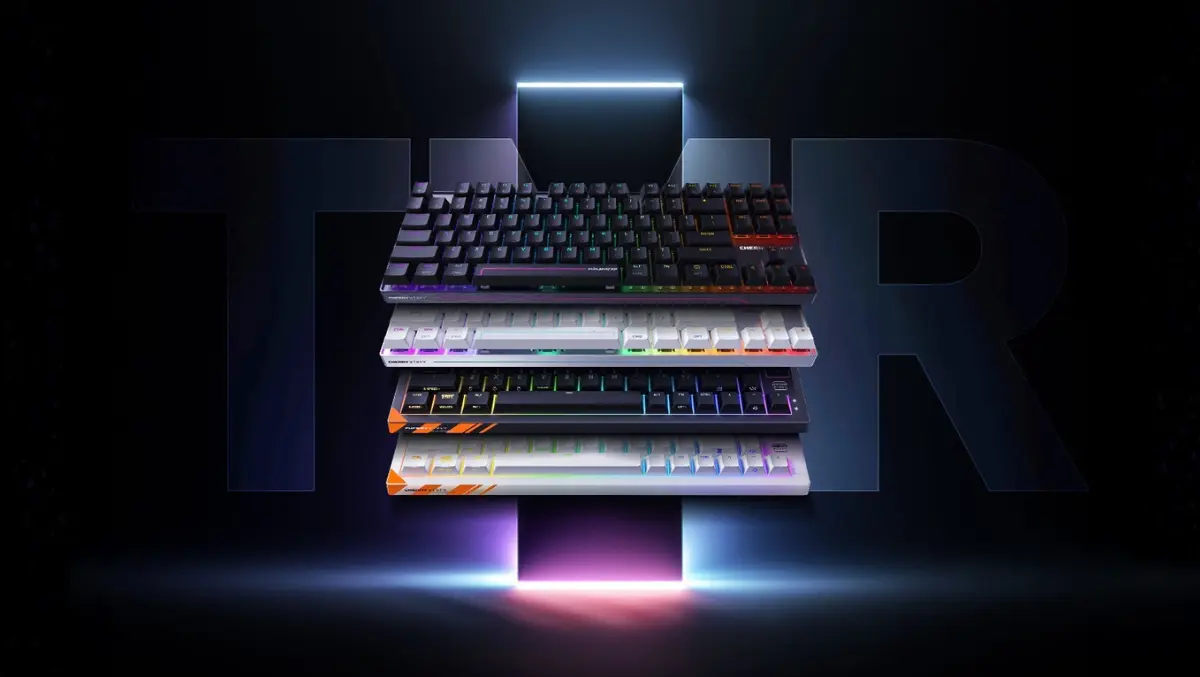
Cherry debuts TMR magnetic gaming keyboards at 8k Hz
Tue, 13th Jan 2026.webp)
Cherry Xtrfy has launched its first magnetic switch keyboards, introducing tunnel magnetoresistance sensing as it enters a market that has largely centred on Hall effect designs.
The company said it will sell two models. The MX 8.2 Pro TMR Wireless goes on sale at the end of January with a recommended retail price of GBP £199.99. The K5 Pro TMR is due in spring, with pricing due closer to release.
Cherry positions the move as a shift in the way magnetic key presses get measured. The firm said TMR offers "greater precision and significantly lower power consumption" than other approaches in the segment.
"The demand for magnetic switch keyboards keeps growing, but with TMR, we're taking it further. The MX 8.2 Pro TMR delivers ultra-fast wireless performance and everything users expect from a magnetic keyboard, but with higher precision and more flexibility. With hot-swap support for both magnetic and mechanical switches, the typing experience can be customized in more ways than ever. And this is just the beginning. We're expanding the TMR lineup with the K5 Pro TMR keyboard this spring", said Joakim Jansson, Director of Product Management, CHERRY.
Wireless model
The MX 8.2 Pro TMR Wireless is a tenkeyless keyboard with an aluminium top frame and PBT keycaps. Cherry said it uses Cherry MK Crystal Magnetic switches and TMR sensing. The company said the sensing registers input with 0.01 mm precision.
Cherry said the keyboard runs wirelessly with an 8000 Hz polling rate. The company described this as reporting "up to eight times every millisecond". It also said the higher rate makes a computer "react faster to every keystroke".
The MX 8.2 Pro TMR Wireless works with Cherry MagCrate software. Cherry said users can change actuation points and assign multiple actions to a single key based on press depth or duration.
Cherry also highlighted hot-swap support for both magnetic and mechanical switches across most keys. The company said this design allows users to change switches without soldering. It framed the feature as a route to different typing and gaming preferences within the same keyboard layout.
Cherry described the model as aimed at competitive play and everyday use. Tenkeyless layouts remain popular among gamers who want more mouse space and a smaller overall footprint than full-size boards.
Compact option
The second keyboard, the K5 Pro TMR, uses a compact 65% layout. Cherry said it builds on the existing K5 model and adds a magnetic switch configuration.
The K5 Pro TMR is a corded keyboard. Cherry said it uses the same Cherry MK Crystal Magnetic switches with TMR sensing, alongside MagCrate software for configuration.
Cherry said the model increases the polling rate from 1000 Hz to 8000 Hz. It positioned the device as a smaller format addition to the TMR series and said it introduces "a new size and price point".
Market context
Magnetic switch keyboards have become a more prominent category in gaming peripherals in recent years. Manufacturers have focused on adjustable actuation and rapid trigger-style behaviour, which can reset actuation quickly based on how far a key travels.
Most products in the segment use Hall effect sensors. Cherry's decision to push TMR sensing sets it apart from many competitors, though the company did not provide comparative test data in its announcement.
Cherry's launch also adds another area of competition for established mechanical switch brands, including those that supply components across the wider keyboard market. Many buyers now expect software-based customisation and modular features such as hot-swapping, which have spread from enthusiast keyboards into mainstream gaming models.
Company footprint
Cherry makes keyboards, mice, microphones and headsets for office, gaming and industrial use. It also sells hardware and software products linked to digital healthcare.
The company said it runs operational headquarters in Germany, with production and logistics sites in Germany, China and Austria, plus sales offices in Europe, the US and Asia. It said it has developed products in-house since its founding in 1953.
Cherry said the MX 8.2 Pro TMR Wireless will be available from January 29, while the K5 Pro TMR will follow in spring.