

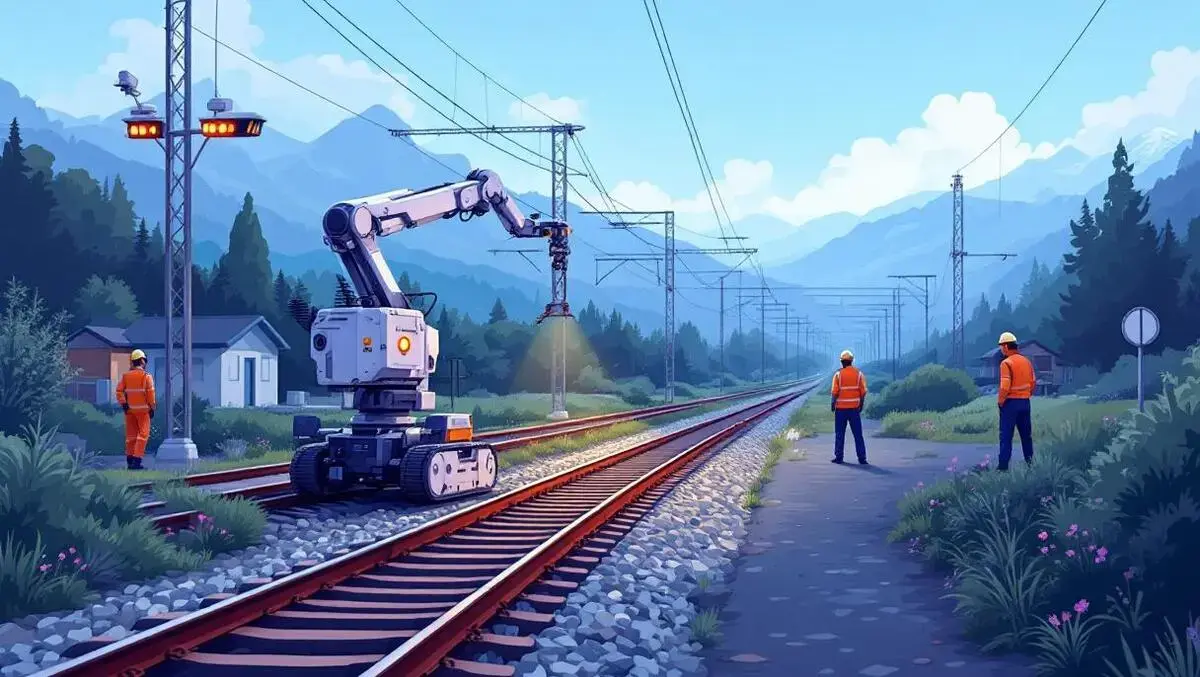
Downer expands rail robotics partnership across region
Fri, 15th May 2026
Downer has expanded its partnership with Future Maintenance Technologies to extend the use of rail maintenance robotics across Australia and New Zealand, while also supporting entry into selected new markets.
The companies are promoting a model in which robots work alongside maintenance crews rather than replace them, delivered through Downer's digital asset management business, XDNA.
Future Maintenance Technologies' robotic inspection systems, known as Rail Facility Drones and the Train Robotic Examination System, are already operating in live Australian rail settings. They inspect under carriages, in confined spaces and at height, with the resulting data analysed using artificial intelligence and reviewed by human specialists.
The systems are designed to improve inspection consistency and reduce the time workers spend in hazardous positions, allowing technicians to focus on diagnosis, planning and other engineering work.
The partnership began at Downer depots in Auburn, New South Wales, and Pakenham, Victoria. Teams from Downer Rail & Transit Systems worked with Future Maintenance Technologies engineers to test autonomous inspection tools on the Waratah and HCMT fleets.
That work has since moved from trials to live deployment and broader commercial use. The latest phase formalises a relationship built over several years of joint development and customer projects.
Safety has been central to the design. Each platform uses multiple sensors to monitor its surroundings and can slow or stop when people or objects enter a defined area, allowing workers and machines to operate nearby without the larger exclusion zones often associated with industrial automation.
Downer is also looking to expand the robotics work into New Zealand, where it sees the model as relevant to rail and infrastructure maintenance.
People and machines
Darren Hungerford, Executive General Manager, XDNA, outlined Downer's position on automation.
"We have never believed the version of the automation story that goes 'robots in, people out'. What really works - what our customers want and what we have proven on the ground with FMT - is robots and humans in harmony. The robots take on the jobs that are repetitive, hazardous or simply impossible to do consistently at scale, and our skilled people get to spend their time on the higher-value engineering work that keeps fleets running," said Darren Hungerford, Executive General Manager, XDNA, Downer.
He said Downer had supported Future Maintenance Technologies from an early stage because the operational benefits were already visible.
"We backed FMT early because we could see the tangible benefits for our customers, safer inspections, better data and more effective use of our workforce. This next phase is about taking what we've proven together and delivering it for more customers, in more markets," Hungerford said.
Future Maintenance Technologies described Downer as its first major industry partner, saying it had provided access to complex operating environments where the technology could be tested and refined. That support, it said, was important in moving from early pilots to broader use.
"Downer gave us the opportunity to demonstrate our technology in a live operational setting at the Pakenham depot. They've worked alongside us at every stage, and that partnership has been very valuable in supporting our progress to date," said Loic Ayoul, Chief Executive Officer, Future Maintenance Technologies.
Expansion plans
The next stage of growth will include new markets beyond Australia and New Zealand. The United Kingdom has been identified as a priority because of similarities with Australia, including ageing rolling stock, workforce shortages and pressure on reliability.
Operators can use the systems to shorten maintenance windows, improve inspection consistency and identify faults earlier through larger data sets and predictive analysis. That also reduces the time workers spend under isolated trains or at height.
Downer has operated in rail services for more than 155 years and views local skills and industrial capability as important to introducing new technology in infrastructure maintenance. It sees that approach as transferable to other markets as the partnership develops.
"The rail industry has talked about the future of maintenance for a long time. With FMT, we're delivering it, practically, safely and with our people at the centre," Hungerford said.