

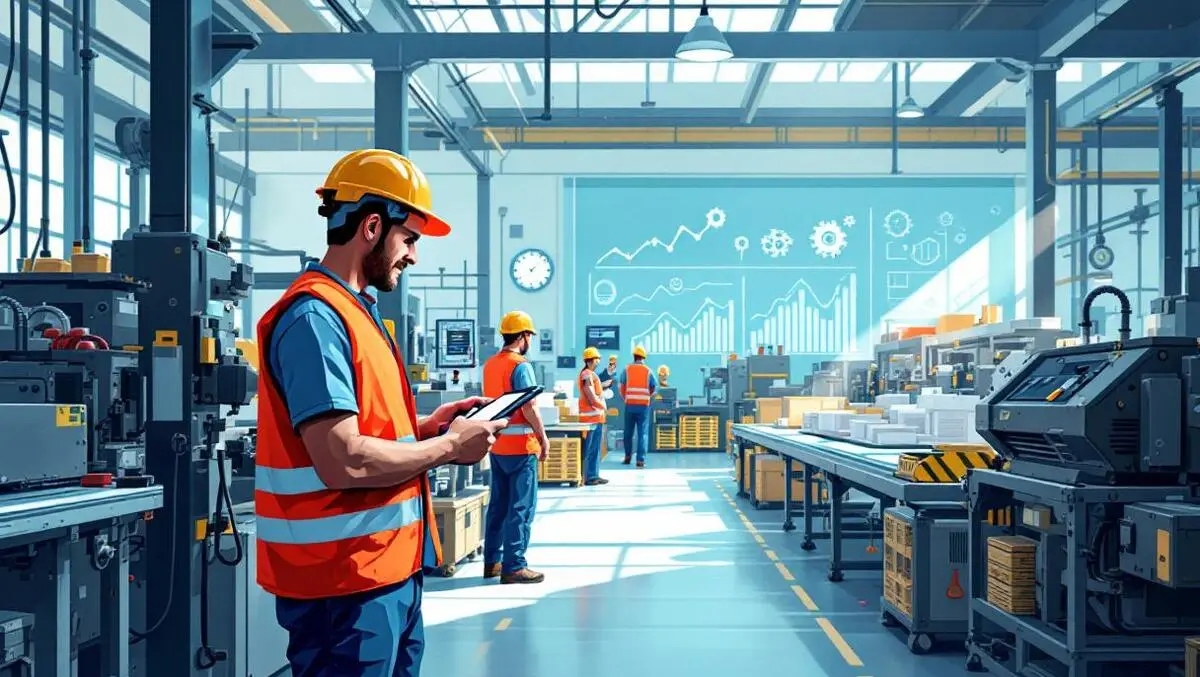
New Zealand backs low-cost digital tools for factories
Tue, 24th Feb 2026%201.webp)
The New Zealand Government is expanding Digital Manufacturing Light, a University of Auckland programme that helps small and medium-sized manufacturers adopt low-cost digital tools.
The expansion will reach at least 180 manufacturers across Auckland and parts of Waikato, Northland and the Bay of Plenty regions that account for about 55% of the country's manufacturers.
Small Business and Manufacturing Minister Chris Penk said the move responds to intensifying international competition and faster adoption of automation and software overseas.
"In an increasingly digital world, overseas competitors are reaping the rewards of greater automation, artificial intelligence, robotics and cloud computing," Penk said.
He said some local firms remain cautious about changing production environments.
"New Zealand manufacturers need these tools and technologies to sharpen their competitive edge, but some are held back by cost or concerns about disrupting their operations, especially where in-house technical expertise is limited," he said.
Low-cost approach
Digital Manufacturing Light focuses on commercially available technology and open-source software. It targets upgrades that can fit around existing production lines, using sensors and software connected to equipment, including older machines, rather than requiring full factory replacements.
Participants receive an assessment of their operations and recommendations on suitable tools, followed by installation support and training for staff on the factory floor.
The model is designed to build skills within each business. Programme staff work alongside a manufacturer's technical employees as changes are introduced.
"A key strength of Digital Manufacturing Light is that it works closely with manufacturers and their own technical staff, building the digital skills into the business that will support sustainable, long-term improvements," Penk said.
Digital Manufacturing Light began as a pilot delivered jointly by the University of Auckland and the Auckland Council. It draws on a UK initiative, Digital Manufacturing on a Shoestring, developed by the Institute for Manufacturing at the University of Cambridge.
Factory data
The work focuses on practical production issues, including job tracking, process monitoring and quality control. It includes retrofitting existing machinery with sensors and software so companies can collect and act on production data.
"Digital Manufacturing Light will support manufacturers to move away from manual and often outdated processes, providing real-time insights into machine performance, bottlenecks, and quality issues," Penk said.
The pilot phase included projects such as automating older welding equipment. They illustrate the programme's emphasis on incremental upgrades rather than large one-off investments, and show how better data can make equipment utilisation and quality issues more visible to supervisors and operators.
Funding package
The Government has committed to a three-year funding package for the expansion, described as up to $475,000 per year from April 2026.
"That's why the Government has committed to a three-year funding package to expand the Digital Manufacturing Light programme, supporting businesses to work smarter, run more smoothly and face future challenges with confidence," Penk said.
Penk also pointed to research from Xero and the New Zealand Institute of Economic Research on the potential economic impact of wider digital adoption.
"The potential benefits are significant. Research from Xero and the New Zealand Institute of Economic Research shows that faster digital adoption across small and medium-sized enterprises could lift national GDP by $8.6 billion," he said.
Industry context
Manufacturing firms often face constraints in capital spending, engineering time and specialist software skills. In many small and medium-sized factories, equipment spans decades and includes machines not designed for modern data collection. That can make full-scale digital transformation expensive and risky.
Digital Manufacturing Light positions itself as a lower-risk pathway. Using off-the-shelf components and open-source software reduces licensing costs and can shorten deployment time. The focus on staff training reflects the reality that new systems fail if workers cannot maintain them, interpret the data, and integrate them into daily routines.
The decision to prioritise regions with a high concentration of manufacturers signals a clustering strategy. Auckland and the surrounding areas include a large share of New Zealand's food and beverage operations, fabricated metal workshops, wood processing, plastics, and specialised component suppliers. These businesses often compete on delivery reliability, consistency and cost-metrics tied directly to uptime, quality performance and scheduling.
In a closing statement, Penk positioned the programme within the Government's wider economic agenda.
"The Government is fixing the basics and building the future for New Zealand. Backing programmes like Digital Manufacturing Light is a smart, targeted investment that helps smaller firms grow, innovate, and contribute to our economy and communities," he said.