

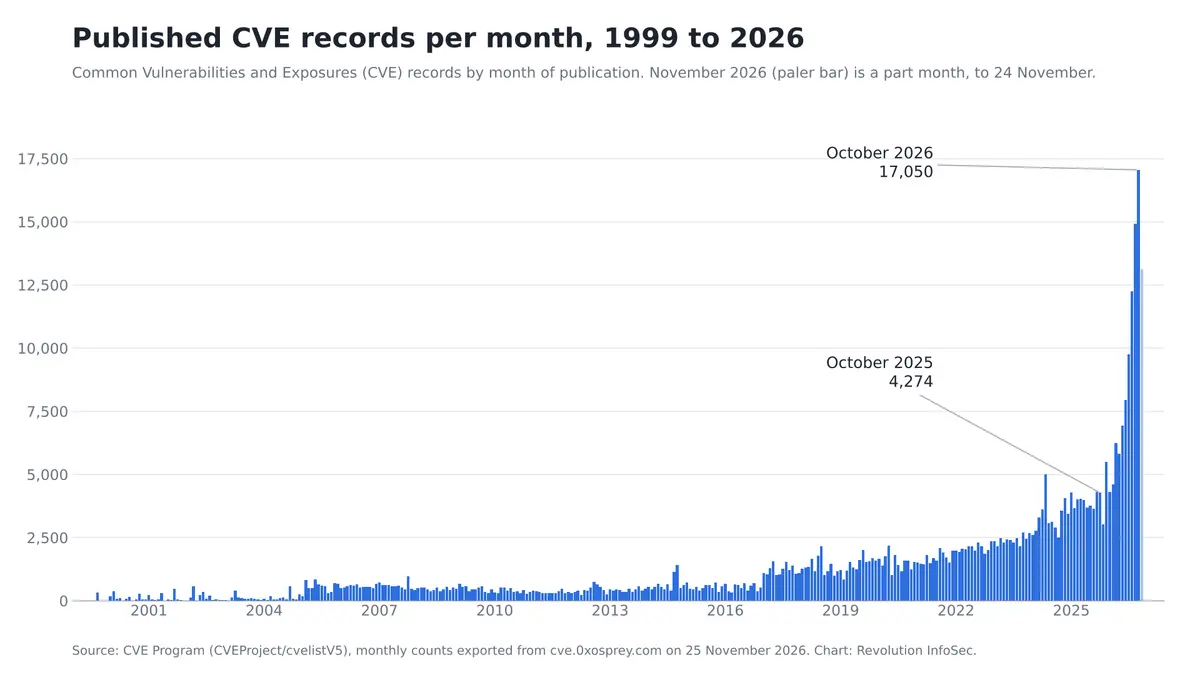
There is a graph I keep going back to. Built from the official Common Vulnerabilities and Exposures (CVE) list, the global register of publicly known software flaws, it tracks every disclosure over the past 27 years. For most of that time the line is a gentle slope. Then it reaches 2026 and heads for the ceiling.
The numbers behind the line are plain. In 2025, itself a record year, 48,150 CVE records were published. By 24 November 2026, the count had already reached 102,962 - more than double the previous year's total. October delivered 17,050, which is about 550 a day and four times the figure for October last year.
Software did not become twice as insecure in twelve months. What changed is who, or rather what, is doing the looking.
What bent the curve
In April, Anthropic announced Claude Mythos Preview, an artificial intelligence model it considered too capable at finding and exploiting software flaws to release to the general public. By late May the company reported that it and around 50 partners had used the model to find more than ten thousand high or critical severity vulnerabilities in some of the most widely used software in the world.
I would, however, be wary of pinning the whole curve on one model. A CVE record does not say how a flaw was found, so nobody can give an exact figure for the share AI is responsible for. But the vulnerability intelligence firm VulnCheck said in November that AI-assisted hunting is driving the majority of what it sees. Oracle's July update patched 1,449 vulnerabilities, against 309 in the same month last year.
Most of that work is being done by defenders, which is good news. The catch is the gap between found and fixed. Access to Mythos is vetted. It would be naive to assume every capable tool will be, and Google's threat intelligence team reported that adversaries using AI to exploit vulnerabilities.
The speed is what should worry us. VulnCheck puts the median time between a flaw being published and being exploited at 80 days for the first half of 2026, down from 120 last year. Where working exploit code is public, CrowdStrike found that 88 per cent of exploitation happened within 48 hours. The share of flaws that get exploited has stayed steady at roughly 1.4 per cent. But 1.4 per cent of 100,000 is a far larger number than 1.4 per cent of 48,000.
Why distance is no defence
New Zealanders often try to tell a comfortable story about cyber security: we are small, we are a long way from anywhere, and nobody would bother with us. The evidence says otherwise.
In the first three months of this year, the National Cyber Security Centre (NCSC) responded to three incidents it classed as highly significant. That category is reserved for events that affect key sensitive data or disrupt essential services at organisations of national significance, and it had not been used since the 2021/22 financial year. The NCSC has noted several high-profile incidents here in 2026, some involving the loss of customer or patient data. In the second quarter it recorded a further 1,129 incidents, and those are only the ones somebody reported.
We run the same operating systems, browsers, firewalls and cloud platforms as everyone else, so every one of those 102,962 flaws is as much ours as anyone's. An automated scanner does not consult a map before it knocks on the door. What we tend to lack is depth. In my experience, most New Zealand organisations do not have a security team. They have someone in IT who also looks after security.
Machines to fight the machines
No human being can read 550 advisories a day, decide which ones matter and patch them before the weekend. The defensive work has to be automated to the same degree as the offensive work.
In practice, that means four things:
-
An inventory of what you run that updates itself, because you cannot patch what you do not know you have.
-
Automatic patching as the default for anything facing the internet, with exceptions that someone senior has to sign.
-
Prioritising by whether a flaw is being exploited in the wild, since a severity score alone will bury you.
-
Monitoring that can spot and contain an intrusion at three in the morning without waiting for a person to wake up.
Commenting on frontier AI in June, the NCSC's Chief Operating Officer, Mike Jagusch, said "the best way to prepare is getting the basic security measures in place". Multi-factor authentication and tight control over who holds administrative access still stop a great deal. The basics simply have to run at machine speed now.
People as the strongest link
Our industry likes to call people the weakest link. I have never liked the phrase, because it encourages organisations to buy tools and write off their staff.
Machines are fast, but they have no sense of what is normal for your organisation. An accounts clerk knows the chief executive does not ask for an urgent payment to a new account at five on a Friday. A board member can ask how long a known hole in an internet-facing system stays open, and who has the authority to shut that system down at two in the morning.
That kind of common sense only works if people are allowed to use it. Give staff the authority to pause, to pick up the telephone and check, and to be wrong occasionally without being blamed for it.
I do not expect the graph to flatten next year. How long a known flaw stays open in your organisation, and whether your people feel able to say that something looks wrong, are both still within your control.