

Rakon launches timing portfolio for AI data centres
Fri, 6th Nov 2026 (Today)
Rakon has launched a timing portfolio for AI data centres and hyperscale infrastructure, covering the communication, synchronisation and compute layers in AI systems.
The portfolio includes oven-controlled crystal oscillators, temperature-compensated crystal oscillators and crystal oscillators for optical transceivers, switching equipment, network timing and compute hardware. The products are aimed at applications ranging from high-speed data centre networking to network interface cards, data processing units and AI accelerators.
The move reflects growing attention on parts of AI infrastructure beyond the processors themselves. As operators build larger clusters of interconnected GPUs and other accelerators, timing accuracy is becoming more important to keep data moving across optical links and distributed compute resources aligned.
In communications, Rakon is targeting reference clocks used in optical transceivers, SERDES and networking equipment. These systems handle large volumes of traffic between AI accelerators, where signal quality and timing stability can affect efficiency across a cluster.
For synchronisation, the range is designed to operate across network layers, from grandmaster clocks and switching infrastructure to network interface cards and processors. This part of the portfolio includes digitally controlled OCXOs, IC-OCXO devices and long-holdover discrete OCXOs.
At the compute level, Rakon is extending timing products into the tray itself, where they can be used in NICs, DPUs and AI accelerators. The line-up includes digitally controlled OCXOs and TCXOs, along with its Niku Ultra Stable TCXOs and compact high-stability TCXOs.
Wil Hsieh, Head of Products (Commercial BU) at Rakon, linked the launch to the wider build-out of AI systems.
"AI performance isn't determined by processing power alone," Hsieh said.
"Keeping data moving quickly and compute resources working efficiently also depends on the timing infrastructure around them. Better timing helps reduce communication and synchronisation bottlenecks, enabling AI infrastructure to make more effective use of its available compute performance. Rakon's portfolio addresses that challenge from optical connectivity and network synchronisation right through to the compute tray."
New products
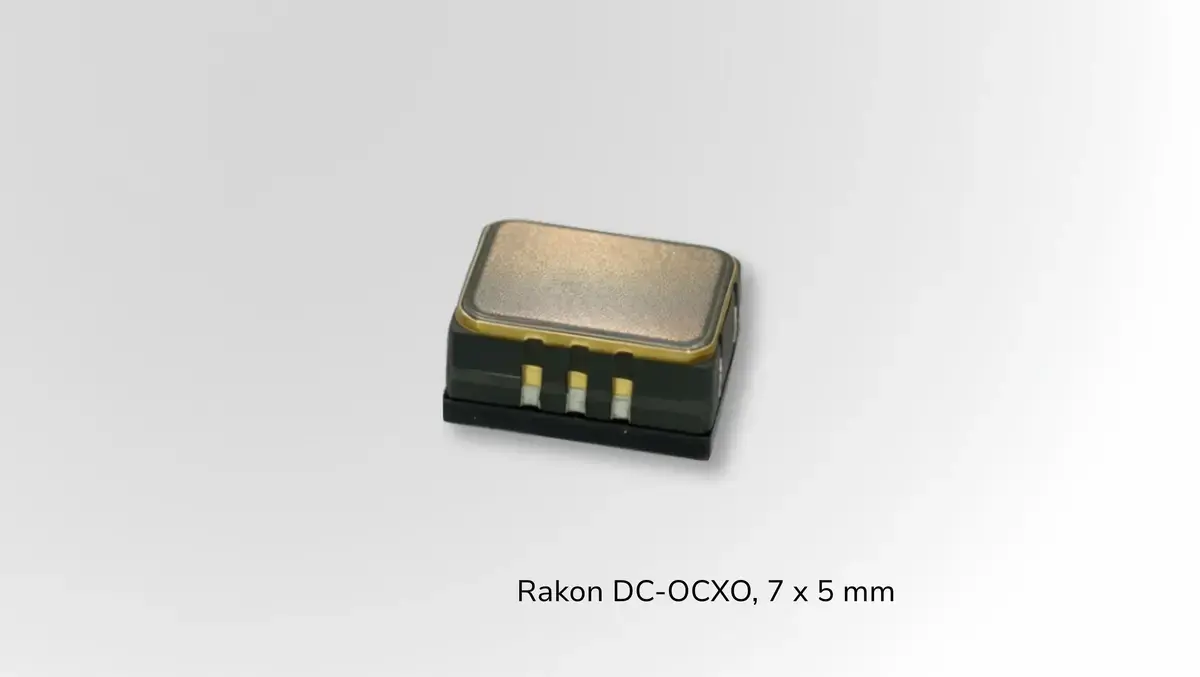
A central addition to the range is the Vulcan ROV7050XD digitally controlled OCXO, which is now sampling. Intended for network timing and synchronisation in AI infrastructure, it combines digital control with programmable frequencies in a 7 x 5 mm-class hermetic package.
Rakon said the ROV7050XD supports frequencies up to 1 GHz, with frequency stability of ±10 ppb and a frequency slope of ±0.5 ppb/°C. The device uses I2C for frequency tuning, allowing designers to adjust output frequency requirements without changing hardware.
The product sits in a part of the market where network timing must balance precision, size and flexibility. In large AI deployments, synchronisation devices are used across scale-up and scale-out architectures, including spine, leaf and Top-of-Rack switching.
Rakon is also extending its XO line to higher frequencies with a new high-frequency, ultra-low-jitter differential series. The current RXO2520NT and RXO2016NT models operate at 500 MHz, and the series is intended to reach 1.25 GHz.
According to Rakon, the existing models deliver 30 fs RMS phase jitter and ±10 ppm FvT. They are available in 2.5 x 2.0 mm and 2.0 x 1.6 mm footprints, with smaller package sizes under development.
AI timing
The launch highlights a less visible part of the AI supply chain. While much of the investment focus has fallen on GPUs, networking silicon and memory, timing components support communication between systems and co-ordination across racks.
As data rates rise, reference clocks are being pushed to higher frequencies, particularly in optical interconnects and next-generation networking equipment. At the same time, tighter synchronisation is becoming more important as AI workloads are distributed across larger numbers of processors.
Rakon said its development work in digital control, high-frequency differential technology, XMEMS resonator technology and ASIC design is feeding into the new line-up. Those technologies are being used to produce smaller devices with higher frequencies, greater stability and lower jitter for data centre applications.
Hsieh said AI infrastructure is changing quickly.
"AI infrastructure is evolving extremely quickly, particularly around network speed and synchronisation," he said.
"Our Vulcan ASIC platform with Digital Control brings greater flexibility to precision network timing, while our new high-frequency XO platform combines ultra-low jitter with increasingly higher frequencies and smaller form factors. These developments are about helping customers get more performance from the infrastructure connecting their AI compute resources."