

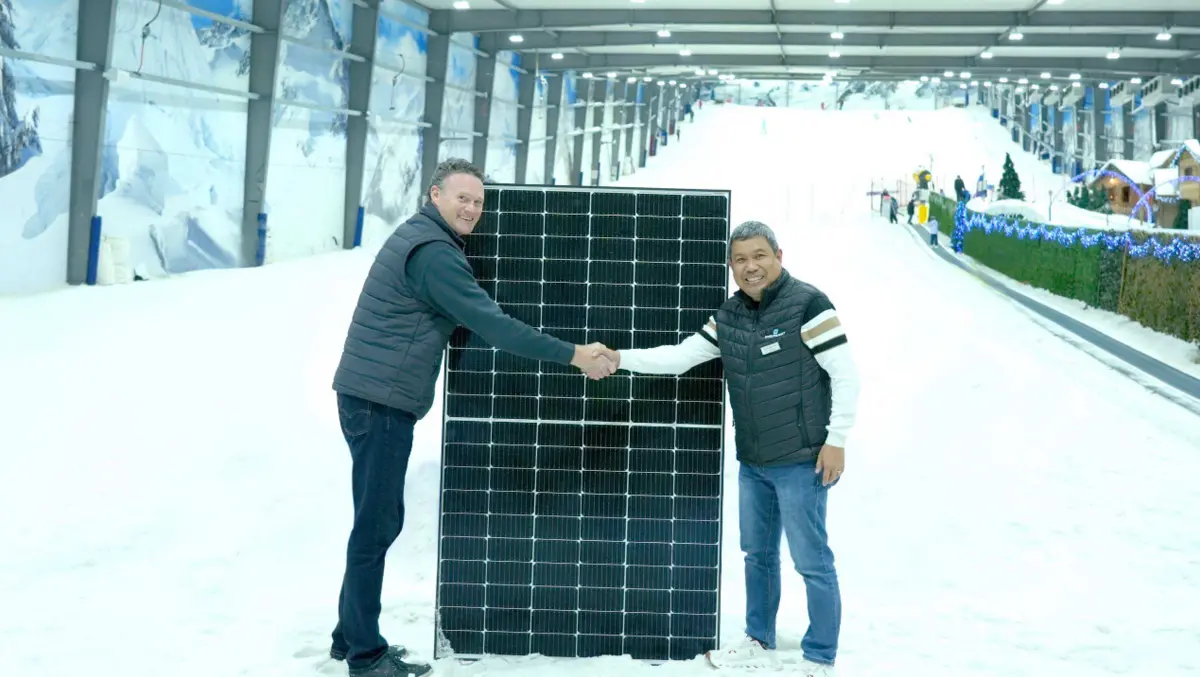
Snowplanet cuts grid power with 1.05MW solar array
Tue, 28th Jul 2026
Snowplanet has completed a 1.05-megawatt solar installation at its indoor ski facility in Silverdale, delivered in partnership with Sunergise.
The system is expected to cut the site's reliance on grid electricity by about 30 per cent. The facility operates around the clock to keep 8,000 square metres of slope at minus five degrees.
Australasia's only operating indoor ski venue uses large amounts of electricity to make snow and maintain stable temperatures inside what engineers describe as a large freezer. The site produces another 80 cubic metres of fresh snow each week to keep conditions suitable for skiers, while cooling demand rises in hotter weather.
Sunergise installed 2,317 ground-mounted solar panels on the hillside next to the facility. Visible from Auckland's Northern Motorway, the array is expected to generate about 1,500 megawatt-hours of electricity a year.
Most of that output will offset daytime consumption, when the venue needs power to keep the building cold in warm conditions. On sunny summer days, when cooling demand is highest and solar generation is strongest, the installation can produce more electricity than the site uses, with the surplus flowing back into the grid.
Snowplanet makes its snow at night when the facility is closed, but the larger energy burden comes from maintaining low temperatures throughout the day. The new arrangement is intended to lower operating costs as well as reduce purchased electricity.
"Keeping the slopes frozen and ensuring a smooth experience for our customers, elite athlete training and school programmes takes around-the-clock power," said Rojie Aguilar, General Manager, Snowplanet.
"Cutting 30 per cent of our grid draw reduces our operational costs too," Aguilar said.
Why ground-mounted
Engineers chose a ground-mounted design instead of placing panels on the roof because the building already carries 150 tonnes of load. Roof penetration also would have created a structural risk because of the waterproof membranes.
The hillside location allowed the panels to be positioned for stronger output throughout the year. That decision was central to the project's economics because Snowplanet's demand pattern aligns closely with daytime solar production in warmer months.
The project was completed under Sunergise's SunPlus power purchase agreement model. Under that structure, Sunergise retains ownership of the system and remains responsible for maintenance, while Snowplanet buys the electricity it produces at a fixed rate below standard grid prices.
That arrangement meant Snowplanet did not need to fund the installation upfront. For commercial property and industrial operators, power purchase agreements are increasingly being used to add on-site generation without committing capital to equipment ownership.
"The commercial logic is clear," said Paul Makumbe, Chief Executive Officer, Sunergise.
"The hottest summer days are when Snowplanet's cooling demand peaks, which matches our maximum solar generation. The project offsets 101 tonnes of carbon annually without requiring any upfront capital from Snowplanet," Makumbe said.
Broader portfolio
Founded in 2012, Sunergise has installed more than 50 megawatts of solar capacity across New Zealand and the Pacific through more than 200 commercial projects. Its previous work includes a 5.3-megawatt installation for Fisher & Paykel Healthcare and a 2.3-megawatt project at Mānawa Bay.
For Snowplanet, the installation links an energy-intensive leisure business to a source of generation that is strongest when refrigeration loads rise. The result is a site where sunlight, once a factor that increased the cooling burden, now supplies part of the electricity needed to keep the slopes frozen.
On the sunniest summer days, when the slopes need the most cooling power and the panels are generating at their peak, the system produces more electricity than the facility can use.