

Spanish photographer wins Epson Pano Awards top title
Tue, 20th Oct 2026 (Today)
The 17th Epson International Pano Awards has named Spanish photographer Daniel Viñé Garcia Open Photographer of the Year and Tomás Sánchez Ruiz Amateur Photographer of the Year. The competition also introduced a dedicated aerial category this year.
The awards drew 4,084 entries from photographers in 93 countries, up 19 per cent on the previous year. Of these, 2,122 were submitted to the Open competition and 1,962 to the Amateur competition, including 680 in the new Aerial divisions.
Garcia took the top Open title with a portfolio spanning the high Andes and the Argentine Puna. His winning image, The Sleeping Giant, was made at Parinacota Volcano in Chile, which rises above 6,300 metres and sits beside Pomerape, at more than 6,200 metres.
"The original capture was a 360-degree aerial panorama made from 33 individual exposures," Garcia said. "After one last burst of light, the landscape gradually took on magenta tones, wrapping the volcanoes and the high-altitude lakes in a particularly special atmosphere. I later refined the framing from the full panorama to concentrate the final composition on the volcanoes, the light and the shapes of the landscape."
He also placed in the Open Nature and Landscape category with Cathedral of Starlight, a night panorama taken at about 3,100 metres in the Argentine Puna, and My Perfect Night, photographed on a salt flat in Catamarca at more than 3,300 metres.
Aerial focus
The addition of aerial categories in both the Open and Amateur competitions was the main change to this year's awards. Organisers said photographers had called for a dedicated aerial division throughout the competition's 17-year history.
Craig Heckenberg, Managing Director of Epson Australia and New Zealand, said the category reflected changes in photographic practice. "Photographers at every level, from first-time entrants to established professionals, use the Pano Awards as a benchmark for their own work," he said. "The aerial category is a perfect example of why the competition has stayed relevant for 17 years. It responds to what photographers are actually doing and gives the global industry a view of where the craft is heading next."
David Evans, Founder and Curator of the Pano Awards, also pointed to the strong response from entrants. "In the 17-year history of the Epson Pano Awards, never has a request from entrants been stronger than the addition of a dedicated Aerial category," he said. "The addition of a new Aerial category this year in both the Open and Amateur competitions was therefore expectedly popular, with some 680 Aerial entries. The aerial perspective opens up so much of the world above tripod level and the panoramic format lends itself beautifully to this way of seeing. I look forward to watching how this category will evolve over coming years, as technology enables photographers to push their own boundaries and limits."
Category winners
The Epson Digital Art Prize, chosen by the executive team at Epson Australia from the top 50 Open entries in each category, went to The Rugby Players by Preeti and Prashant Chacko of India.
"Southern white rhinos, in their normal state, are surprisingly unthreatening: calm grazers that move at a leisurely pace. One morning at Solio Game Reserve in Kenya, we were photographing a group of eight rhinos with a few cattle egrets walking among them, a rare sight in most other national parks. Something suddenly shifted and five of the rhinos broke into a run. We understood in that instant why a group of rhinos is called a crash. Neither of us has ever played rugby, but from the point of view of the egrets, this is how we imagine a forward pack must look, heads down and all that weight already committed," the Chackos said.
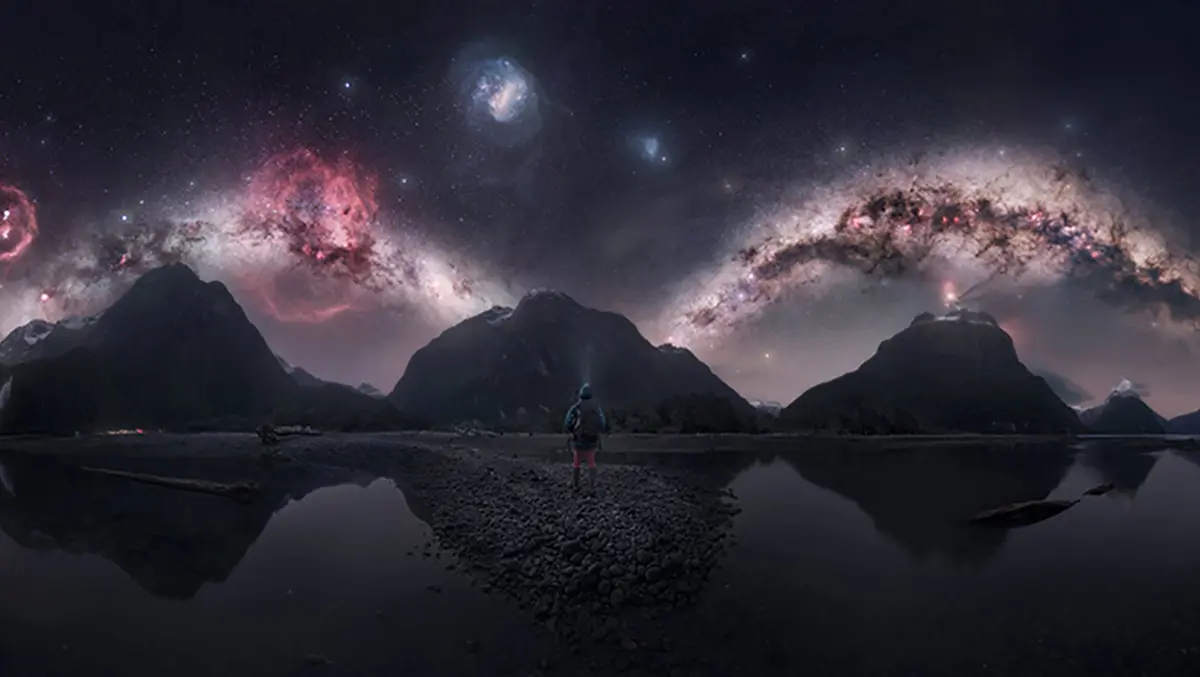
Mikel Iraeta of Spain won the Open Nature and Landscape category with Double arch on Milford Sound. "Milford Sound is a place where it rains on average 300 days a year," Iraeta said. "The day before I visited, the access road was closed because of snow avalanche danger. It is very difficult to have an entirely clear night with no rain, no clouds and no moon, and for all of this to coincide at the end of September when it is possible to capture the double arc of the Milky Way. The final image is the result of combining 107 different photographs."
Xuecheng Liu of the United States won the Open Built Environment category with Centre of the Cosmos, a stitched panorama of Times Square from above. "Times Square is one of the most photographed places in the world, so my challenge was to find a perspective that could make such a familiar place feel unfamiliar again," Liu said. "I stitched together 25 frames to create an ultra-wide aerial panorama, with countless points of light resembling stars surrounding the centre of a galaxy."
Francesco Dall'Olmo of Italy placed second in Open Aerial with Boreal Wings. Wutimet Bunyasirisith of Thailand was named Southeast Asia Open Photographer of the Year for The Emerald Arch Over Lofoten, taken at Skagsanden Beach in Norway.
"The Northern Lights flared up and curved perfectly around the mountain," Bunyasirisith said. "The display was so immense that even my 12mm ultra-wide lens couldn't capture the entire scene in a single frame. My only choice was to shoot a panorama. The conditions that night were brutal: freezing cold, biting winds, and I had to wade into the icy seawater to get the shot."
Amateur awards
Sánchez Ruiz took the Amateur Photographer of the Year title after winning the Amateur Nature and Landscape category with Double Arch Over Stokksnes in Iceland. His Amateur Built Environment entry, Westminster Abbey, was also recognised.
"On the night I took this photograph, the aurora forecast was not particularly promising," Sánchez Ruiz said. "When I pulled back the curtain of our hotel room and saw a green glow in the sky, I knew this could be the night we had been waiting for. The black sand was completely covered in freshly fallen, untouched snow. And there I was, finally taking the photograph I had been waiting for, with a smile on my face."
In the Amateur Aerial category, Xuejun Long of China won with Journey of Life, made at Lake Magadi in Kenya. "As the freshwater evaporated, chemical deposits on the lakebed were exposed, forming interconnected patterns," Long said. "I was lucky to catch this moment and a flock of flamingos flew in, adding life and creating a dreamy, magical scene from the sky."
Sebastián Cantos Navalon of Spain won Amateur Built Environment with Stairs from Earth to Heaven and placed second with Sphere, both photographed at the City of Arts and Sciences in Valencia. "I used a wide-angle lens and created a composite image from eight shots, aiming for the curved lines of the staircase to guide the eye from the ground towards the sky," Navalon said.
Elsewhere, Marcio Esteves Cabral of Brazil was named VR/360 Photographer of the Year for Diving in a blue dream, with Luis García Márquez of Spain placing second with Harvest of Light. Max Terwindt of the Netherlands received the Curator's Award for Antarctic Nights, while Szabi Nemeth of Australia won Highest Scoring Vertical Image with Between Giants and Vitaly Golovatyuk took Highest Scoring Gigapixel Image with X marks the spot.
"It was my first time there and the whole experience was truly magical," Terwindt said. "We had a special licence to fly our drones. As it never becomes dark in the Antarctic summer, the sunset slowly faded into the sunrise, so it went from golden hour to blue hour to golden hour again."